There’s a lot of information on recovery out there. I will point out the strengths and weaknesses of that information so that you don’t get bamboozled by the misinformation out there. This post covers:
- The scientific literature | 23 randomized controlled trials
- Recovery stories | 180+ recovery stories
- Patient surveys | an additional 87 recoveries
- Highly experimental treatments
This information is current as of June 2026.
The scientific literature
Randomized controlled trials (RCTs) can produce the most reliable information as they can control for things like the placebo effect and reporting biases. I keep a compilation of these RCTs over at Long Haul Wiki. The first category / set of RCTs there are focused on the RCTs with positive results.
However, the problem with the scientific research field is that money creates incentives for researchers to release sexy results. Researchers will lose their jobs if they can’t pull in research funding. So, there are many questionable conclusions out there not supported by the researchers’ own data. Sometimes people label their study as “Long COVID” because LC became sexier than what they were originally studying. Of the 8 ‘successful’ RCTs listed, I only consider 1 of them to be credible. (You can make up your own opinion about the others.)
The most credible RCT is for HBOT, or hyperbaric oxygen. The Shamir medical center  study (Zilberman-Itskovich, Shai Efrati et al.) found a statistically significant benefit, while the Karolinska University Hospital
  study (Kjellberg et al.) did not. Unfortunately, the results are conflicting. My notes on both studies are here. The Swedish study didn’t entirely have a true control group as the control group received low pressure HBOT as their sham treatment.
Case studies
There are some case studies with hilarious claims. Microclot ‘missionaries’ put together a pre-print claiming that triple therapy led to 24 out of 24 patients recovering. Every. Single. Patient.
Patient surveys like the Patient Experiences Survey and the TREATME survey* indicate that many people tried triple therapy. The recovery rate isn’t close to 100%.
*Search for triple therapy in the TREATME supplemental excel spreadsheets.
I don’t find case studies to be that useful because of all the shenanigans in this space. Sometimes the patients in a study will actively dispute what the researchers are claiming in their published paper.
Patient surveys and recovery stories
In the Patient Experiences Survey, there was data on 87 recoveries out of 1173 people with severity data. That was turned into a list of almost 110 different treatments that were reported as helping the most. That list may be useful as treatments not on the list don’t have any successes among the 1173 people surveyed. This can help weed out the treatments that aren’t as compelling.
One of the issues with the patient survey data is that the ‘successful’ treatments were all over the place.
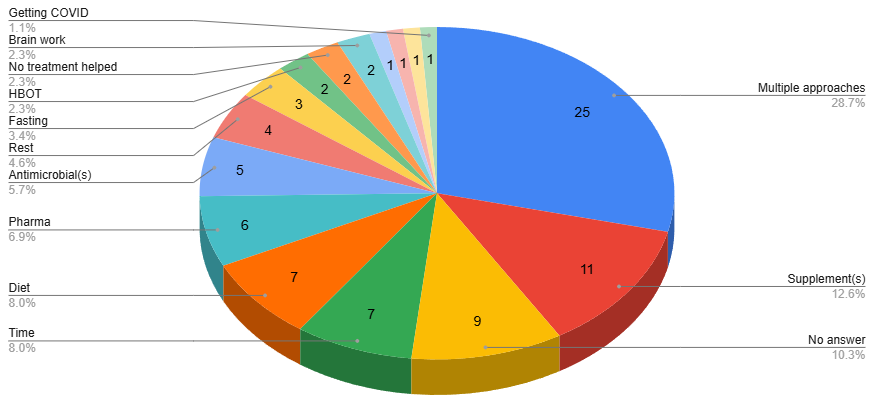
Most of the popular Long COVID theories (e.g. taking antivirals to deal with SARS2 persistence) are represented on this list. It’s unlikely that all of the conflicting theories are all true at the same time.
An even bigger issue is that the patients simply may not know what helped them.
- RCTs have been unable to ‘replicate’ what patients are rating highly. (*The mixed HBOT results are an exception.)
- There is a bias towards rating treatments positively rather than negatively.
- Patients have different styles when it comes to filling out surveys. Some people will rate almost every treatment highly.
- The passage of time, which is not a real treatment, outperformed almost every other treatment.
Recovery stories
Summary: The treatments mentioned depend heavily on demographics. Popular treatments and hyped treatments will show up more in recovery stories; these vary from support group to support group. Groups have different politics surrounding the evils of GET+CBT, the ‘Trump’ drugs (ivermectin and HCQ), COVID vaccination, etc. etc.
Weaknesses: Recovery stories on forums, Reddit, Youtube, etc. may have unusual definitions of the word ‘recovery’. Somebody may see themselves as recovered even though they can’t go back to their old job. In the Patient Experiences Survey, patients were asked about their status based on 3 dimensions- ability to work, ability to walk, and suffering from symptoms. That moves everybody towards a more common definition of ‘recovery’ (able to walk and work, with minimal suffering from symptoms). Most recovery stories don’t have that rigour in defining recovery the same way.
Also be careful with brain retraining as some of them are financially motivated. For example, they may be paying to get onto a Youtube channel.
Where to find recovery stories
-
Compilation of 60 r/LongHaulersRecovery stories, with ChatGPT summary - The summary is useful. Surprisingly, exercise was mentioned by 51 out of 60 stories. You may want to be careful as exercise likely causes more harm than good. While the summary may have AI hallucinations, you can go into the spreadsheet and read the stories for yourself.
- The rest of r/LongHaulersRecovery - you can search the sub based on specific keywords like fatigue, brain fog, etc.
-
Youtube playlist of recovery stories - A quick entry into what’s on Youtube. If a channel has a lot of recovery stories (e.g. Raelan Agle), only a few of those videos will be on the playlist. You’ll have to click on the channel to see what else is on it. Youtube is full of brain retraining recoveries.
-
120 ME/CFS Recovery stories - recovery and improvement stories from various treatments such as antiviral drugs, immune boosters, and other types of drug and supplementation.
-
87 recoveries in the Patient Experiences Survey data - Go into the spreadsheet for the raw-ish data.
NIH’s longitudinal study
The NIH’s research program on Long COVID tracked patients over time. To briefly summarize: some people naturally recover over time. See profiles C and D below:
Figure 3 from Long COVID trajectories in the prospectively followed RECOVER-Adult US cohort - PMC
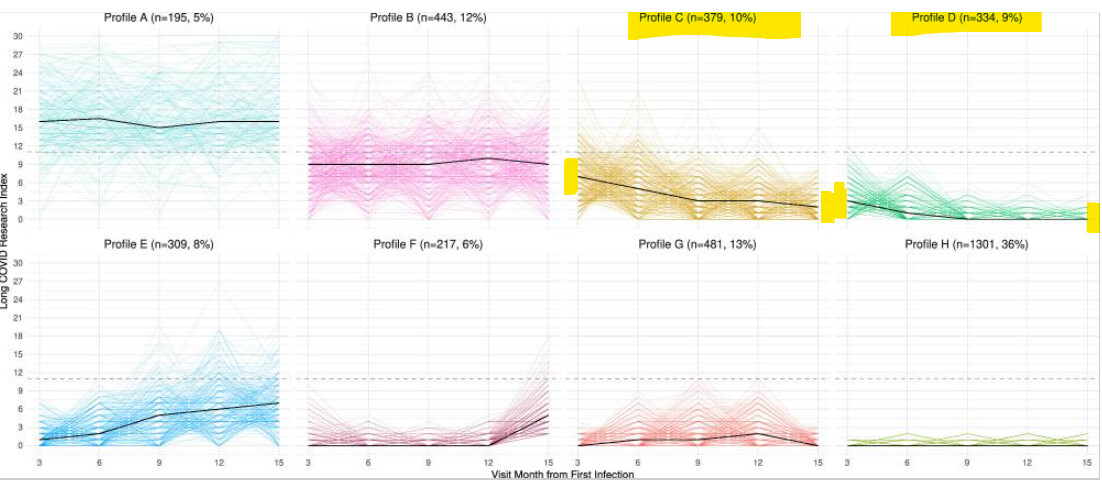
Natural recovery seems to be happening to lucky people. We’re not really sure why though.
And now we start scraping the bottom of the barrel
Highly experimental treatments
Here’s some basic information on how to get access to experimental healthcare.
Having done it myself (e.g. ex Soviet bloc antivirals), I would not recommend it. There’s no shortage of other patients willing to put their bodies on the line. They will try it so you don’t have to- just have a little patience.
The evidence based for experimental treatments is very sketchy. The people who are crazy enough to do this may be crazy in other ways.
Eureka Health
Noah Macca scraped posts from Reddit and Twitter to extract patient-reported experiences regarding treatment.
- r/VaccineLongHaulers: results
- r/LongCOVID: results
- r/Lyme: results
- r/MCAS: results
- r/CFS: results
- r/Dysautonomia: results
While the data is very interesting, it does suggest that there is a strong bias towards ‘everything works’.
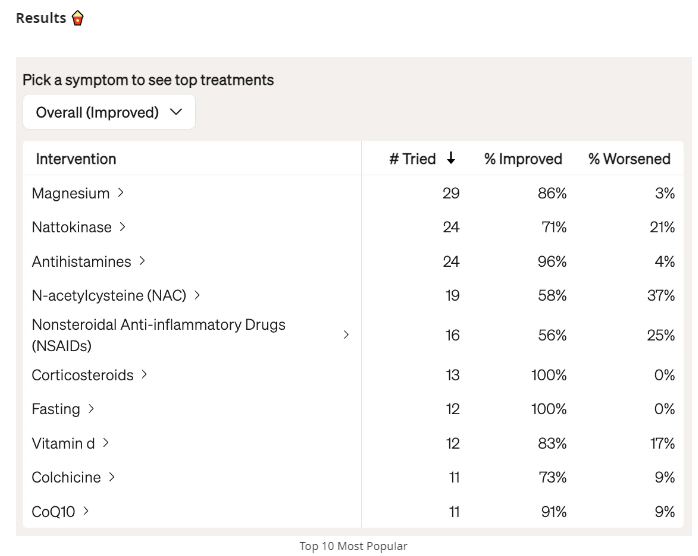
RCT and survey data suggests that the response rates are much, much lower than what people are reporting on social media. I personally believe that there’s a strong bias towards only posting positive results on social media. Partly, this is because you will get random attacks from people if you say negative things about a treatment. So a lot of people don’t bother.
What doctors are trying
Long Haul Wiki has a list of what doctors are trying. Scroll down to section 4 “Doctors treating” to see a list of those treatments.
I would be extremely cautious with the list because the recommendations are often not guided by any evidence. It’s possible that some of the people giving medical advice have had a scientific paper retracted because the paper was a scientific fraud. There are also cases where the doctor claims recovery while the patients publicly dispute that doctor’s claim.
I’m sorry for being jaded and cynical but I’ve seen too much outrageous behaviour. I’m sick and tired of patients being scammed with fake medicine, fake diagnoses (e.g. using vibes to diagnose every patient with chronic Lyme), and the business model of exploiting desperate people.
The dangerous allure of information on the Internet
I know that the Internet is an information superhighway where you can find the answers to your problems. However, I’m going to be responsible here and I’m not going to set a trap for you. The actual answers aren’t that great because there’s so much about medicine that we don’t know. However, it’s important that we don’t get ourselves into trouble. That’s why I try to explain the caveats to the recovery stories and supposed answers out there.
On a practical level, if you can figure out what level of risk you’re comfortable with, then you can filter out all of the crazy stuff that exceeds your threshold. That’ll help you sift through possible medical options.
I hope this helps! I am fortunate enough to have recovered and I hope more people get to that point. 