News update… a preprint for the Recovery study was published on Jan 12, 2024. The Recruitment section below explains why I’m not rushing to accept the conclusions of the study.
Akiko Iwasaki, one of the co-lead principal investigators, has a Twitter thread on the study which provides a great summary of the pre-print.
Here’s one of her tweets:
Survey of changes in overall health indicated that while the majority felt better after vaccination over the course of the study, some reported worsening, while others had no changes in their symptoms. Very consistent with other patient survey data. (7/)
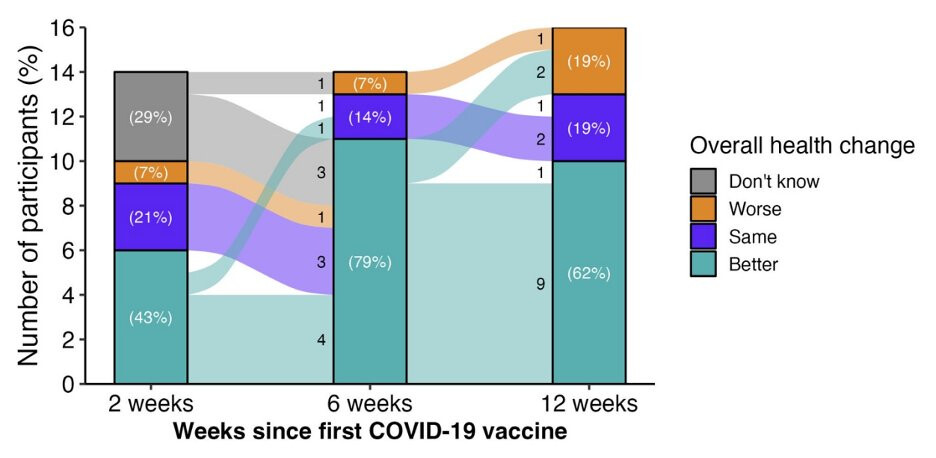
She’s suggesting that vaccination in Long COVID patients is more likely to cause them to feel better rather than worse. But to be clear, she points out the limitations of the study (e.g. very small sample size) and is not saying that it is gospel.
Recruitment numbers may be conflicting
The pre-print provides data on 16 patients, well below the original target of 100. I do not know if the researchers are only providing data on a subset of patients. If that were the case, it would raise potential questions regarding whether or not data manipulation occurred. (Slicing up the entire patient population into subgroups is one way to manipulate the data.)
A Mercury News article seems to provide a different perspective on what happened in the study. It states that the pilot already had 20 patients, more than the 16 patients mentioned in the pre-print.
To study the phenomenon, a new nationwide project is being launched by Yale School of Medicine scientists. Expanding on an initial pilot project of 20 patients, they hope to recruit at least 100 people to determine the influence of vaccination on symptoms that persist months after COVID infection.
Published May 1, 2022. https://archive.ph/1XoZm
Compare that to the pre-print:
Among 429 individuals screened between May 3, 2021 and February 2, 2022, 22 met inclusion criteria and consented to participate and 16 individuals completed the baseline survey and subsequently received a first dose of a COVID-19 vaccine.
Secondly, the article suggests that the study was expanded from people near New Haven (Yale campus) into a nationwide study, so that participants didn’t have to live near Yale. So, you might expect that the study would be:
a. Nationwide
b. Have potential participants from May 2022 onwards.
Yet the pre-print states that it is only giving data on patients from February 2, 2022 and before, so there wouldn’t be data on nationwide patients recruited around May 2022 or afterwards:
This report presents findings from 16 participants recruited between May 3, 2021, and February 2, 2022.
The pre-print also doesn’t suggest that they converted the study into a nationwide study:
Participants also had to be willing to travel to New Haven, Connecticut to provide blood and saliva samples.
Let’s suppose that all patient data was reported
If that’s the case, then the science would be conflicting as multiple surveys report the opposite- a higher chance of harm than good when vaccines are given to chronic illness patients. See the slides in the video description here for a compilation of some data.
It could be the case that the survey is measuring how patients respond to surveys rather than actual medical outcomes. This would mean that self-reported outcomes are often unreliable, patients shouldn’t be trusted (in most cases), and Long COVID is just really hard to research without objective outcomes (e.g. employment, HR measurements for those with POTS, not-that-safe exercise testing, etc.).
Conflicts of interest
Iwasaki and Krumholz were funded by Pfizer to run the Pax for LC study. Presumably this would be disclosed in the final publication.